Short answer: the insert brings its own
Almost every owner in Paramount who books an insert asks whether the chimney needs relining first. For a sealed gas insert, the answer is usually no, because the insert arrives with its own vent pipe and that pipe runs the full height of the chimney. In effect, the vent kit is the liner. Gas logs and older vented gas appliances are a different story, and that is where a liner earns its keep.
Here is the reasoning for each, so a quote that adds a liner, or leaves one out, makes sense to you.
Why wood and gas ask different things of a flue
A wood fire sends hot, smoky gas up the chimney. The clay tiles inside an older masonry chimney were built for that: they get hot fast, the smoke rises quickly and leaves through the top.
Gas burns cleaner but sends up a lot of water vapor and less heat. In a wide, cold masonry flue, that vapor can cool before it reaches the top, condense on the tile and run down the joints. Over a few winters the mortar near the crown softens and crumbles, and the water stains the brick on the outside. A flue sized for a big wood fire is often far too large for a small gas flame, which makes the problem worse.
Sealed inserts: the pipe is the liner
A sealed insert pulls fresh air in through one channel and sends exhaust out through another, both running inside the old chimney from the top down to the unit. Some kits use two separate pipes; others put a smaller pipe inside a larger one. Either way, the exhaust never touches the old clay. The masonry becomes a sleeve that protects the pipe.
So an insert does not need a separate liner. It still needs:
- A chimney that stands plumb with no loose brick at the top.
- A crown that sheds water, so rain does not sit around the vent pipes.
- A path down the flue wide and straight enough for the pipes to pass.
- A top plate and cap that seal the opening around the pipes.
Gas logs: the old flue does the work
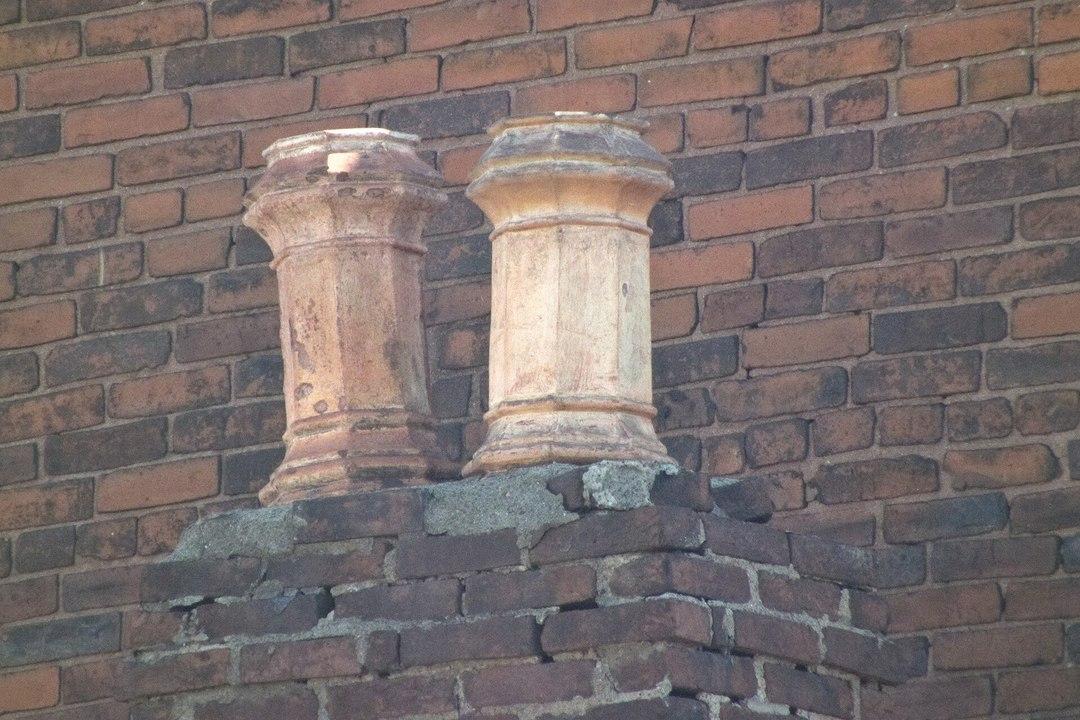
A vented log set burns in the open firebox, and its exhaust rises up the old flue just as wood smoke did. That means the condition of the tile matters. A cracked or missing tile lets exhaust and water reach the brick and the wood framing beside the chimney. If the camera shows broken tiles, we talk about a liner before the logs go in.
For gas logs the liner is normally a stainless pipe dropped through the flue to just above the firebox, matched to the log set and capped tight up top. It gives the exhaust a smooth, right-sized path, so the vapor leaves before it condenses. Our chimney liner installation page has more.
Finding out which you need
The camera inspection, Level 2, is how we see the inside of the flue. Here it costs $400. We record the tile from top to bottom, note cracks, gaps and any tile that has slipped, and look at the crown, the brick above the roofline and the stack through the attic. Changing the fuel a chimney serves is one of the moments NFPA 211 names for this level.
If you are going with an insert, the inspection mostly tells us whether the chimney can carry the pipe and whether anything at the top needs fixing first. If you are going with logs, it decides whether the old tile is fit to carry the exhaust.
What sets the price
For an insert, the vent pipe is part of the installed range, $2,850 to $5,750 on this site, so there is no separate liner charge. A gas log liner has no fixed price on this site; we size it after the camera run and put the figure in writing before work starts. The things that move it:
- How tall the chimney is.
- The size of the log set it has to serve.
- Whether the flue is straight or has an offset.
- Whether the damper or the smoke chamber must be altered for the pipe to pass.
- The condition of the crown and the top of the stack.
Any crown or masonry work found on the camera run gets its own line. If water has been getting in at the top, we may add a leak repair, $575 to $3,450, or a cap. The cap is quoted after we measure; size and material set its price.
Use the form to tell us whether you are leaning toward an insert or logs and roughly when the chimney last had a fire in it.
Book the camera inspection and say which gas option you are considering.
A note on factory-built fireplaces
Some homes around Paramount have a metal fireplace with a metal chimney instead of brick. Those are a different system. They are listed and tested as a whole, so a liner is not added; a gas appliance goes in only if it is listed for that fireplace. We read the label first.
Owners ask
Can I use the old clay liner if it looks fine from the firebox? Looking up from the firebox shows only the bottom few feet. The camera shows the rest.
Is aluminum pipe acceptable? Some insert kits use it and are listed that way. We follow the maker's instructions for the unit you choose.
Does a liner stop a leak? No. A liner guides exhaust. Water comes in through the crown, the flashing or the brick, and that is a separate repair, see chimney leak repair.
Next
To find out what your chimney needs before the switch, start on our contact page. Tell us the gas option you are weighing and we set up the camera visit.
Want the Options Priced for Your House?
Chase Chimney Solutions visits homes around Paramount to measure the firebox, check the flue and gas supply, and write up each gas option with what it costs and what the chimney needs first.